
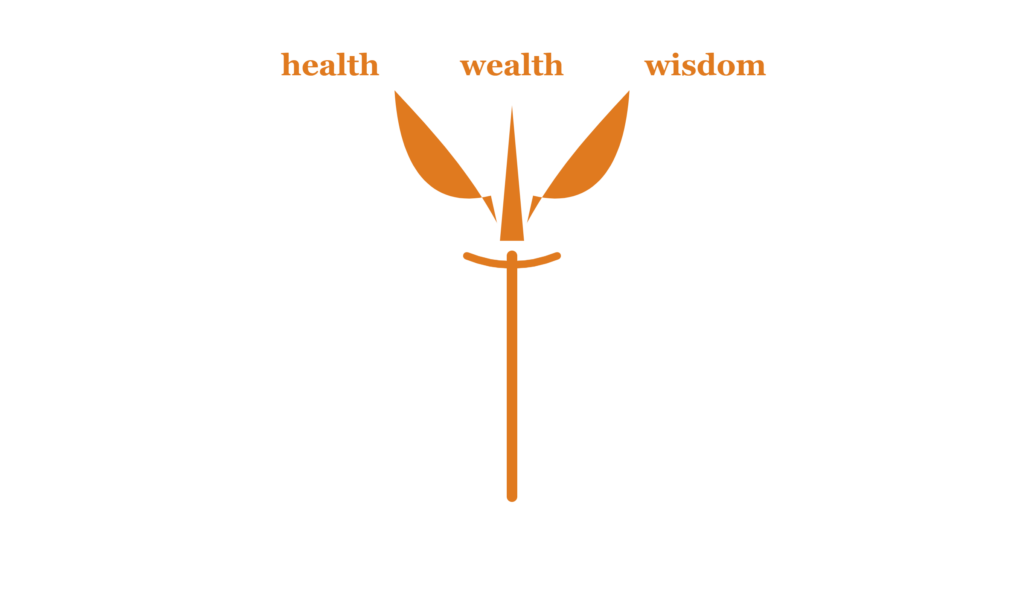
Components of Wealth
Wealth is not a single thing. It is a constellation of interlocking elements that together form the structural layer of human life. These components are not separate pursuits — they are the same current, moving through different channels.
Work, family, skill, earning, responsibility, education, inheritance — these are not categories to be checked off. They are forces that interact, reinforce, and sometimes contradict each other. To understand Wealth is to understand how these components function, separately and together.
Work
Work is not employment. Employment is a form. Work is the substance.
Work is the application of human capacity to create, solve, and produce. It is the primary way individuals interact with and shape their environment — not merely a means to an end, but a fundamental expression of human agency.
Work is: the transformation of effort into value; the engagement of skill with circumstance; the exercise of responsibility over time; the contribution to something beyond oneself. It is not aspirational. It is operational.
You do not choose whether to work. You choose what form your work takes. Life demands contribution; work is the channel through which contribution flows.
Work appears in many forms — Labor (physical, immediate), Craft (skilled, refined over time), Profession (structured, credentialed), Creation (generative, enduring), Care (relational, often invisible), Service (responsive, essential). None is superior to the others; they are different expressions of the same current. What matters is not the form, but the engagement.
Work shapes identity — not because work defines a person, but because what a person does over time accumulates into who they become. The question is not “what do you do?” but “what do you build through what you do?”
Family
Family is not a support system. It is the primary arena in which Wealth is learned and transmitted.
Family is: the first encounter with obligation; the primary context for learning responsibility; the crucible where values are formed; the network that carries individuals across transitions; the structure that transmits knowledge, networks, and capacity across generations. It is not sentimental. It is structural.
In a family, obligation is learned by observation, not instruction — a child absorbs what it means to hold a household together. Values are transmitted through lived practice, not lectures: what is celebrated, tolerated, or punished. Networks are inherited — who a family knows and what it can call upon are forms of Wealth rarely discussed but deeply consequential. And the concept of “enough” is formed early: what is normal, expected, sufficient — shaping ambition, contentment, and the capacity to recognize opportunity.
Family appears in many forms — Blood (inherited, unchosen), Chosen (intentional, maintained), Extended (networked, distributed), Nuclear (immediate, daily), Intergenerational (spanning time). None is superior; what matters is the function — the transmission of capacity, obligation, and understanding across time.
Skill
Skill is not certification. Certification is a signal. Skill is the substance.
Skill is: the accumulated capacity to engage effectively with the world; the refinement of practice through repetition; the ability to recognize patterns and respond appropriately; the translation of knowledge into action. It is not aspirational. It is operational.
You do not acquire skill. You build it — through practice, failure, and the slow accumulation of competence.
Skill appears in many forms — Technical (specific, measurable), Relational (interpersonal, subtle), Cognitive (analytical, strategic), Practical (hands-on, immediate), Adaptive (flexible, evolving). None is superior; what matters is the depth — the extent to which skill enables effective engagement with the world.
Skill degrades without renewal. What was sufficient yesterday may not be sufficient tomorrow — not as punishment, but as pattern. The challenge is not to acquire skill once, but to maintain the capacity to keep building it, which requires attention, practice, and the willingness to remain a learner.
Earning
Earning is not income. Income is a measure. Earning is the process.
Earning is: the tangible outcome of value created and exchanged; the recognition of contribution in material form; the mechanism through which work becomes resources; the bridge between effort and sustenance. It is not aspirational. It is operational.
You do not earn to accumulate. You earn to sustain — yourself, your family, your obligations, your capacity to continue contributing.
Earning appears in many forms — Wages (time-based, transactional), Salary (role-based, predictable), Fee (service-based, negotiated), Profit (outcome-based, risk-involved), Return (investment-based, passive). None is superior; what matters is sustainability — whether earning enables the continuation of work, family, and contribution.
Earning is not personal. It is relational. What you earn supports not just yourself but those who depend on you. The question is not “how much do you earn?” but “what does your earning enable?”
Responsibility
Responsibility is not burden. It is the natural consequence of adulthood and participation.
Responsibility is: the capacity to carry obligation consistently; the recognition that actions have consequences; the willingness to be accountable; the acceptance of what is required. It is not aspirational. It is operational.
You do not choose responsibility. It chooses you — through work, family, and participation in life. The choice is not whether to carry it, but how.
Responsibility appears in many forms — Personal (for oneself and one’s growth), Familial (for dependents, continuity), Professional (for work and outcomes), Community (for collective well-being), Generational (for what is passed on). None is superior; what matters is the carrying — the consistent meeting of obligation over time.
Responsibility grows with capacity: what you can carry at twenty is not what you can carry at forty or sixty. This is not linear growth but the accumulation of experience and understanding. Capacity without responsibility is potential unrealized; responsibility without capacity is burden unmanageable. The two must grow together.
Education
Education is not instruction. Instruction is a method. Education is the substance.
Education is: the structured encounter with accumulated human experience; the process through which capacity is built and transmitted; the cultivation of judgment and perspective; the formation of character and the ability to navigate the world. It is not aspirational. It is operational.
You do not complete education. You engage with it continuously, throughout life.
Education appears in many forms — Formal (institutions, credentials), Informal (observation, experience), Self-directed (reading, inquiry), Transmitted (parent to child, mentor to student), Experiential (through work and relationship). None is superior; what matters is the content — the extent to which education builds understanding and capacity.
Education is the primary mechanism through which Wealth is built, transmitted, and refined across generations. The Sanskrit verse and the Tamil verse, separated by centuries, carried the same truth: education is not about the medium but the message. The message endures; the carriers change. Education is not a stage — it is a current that flows through all of life.
Inheritance
Inheritance is not wealth transfer. Transfer is a mechanism. Inheritance is the substance.
Inheritance is: the transmission of knowledge, networks, values, and capacity across generations; the accumulation of what has been built by those who came before; the foundation upon which the next generation builds; the current that flows from past to future. It is not aspirational. It is operational.
You do not choose whether to inherit. You inherit whether you acknowledge it or not.
Inheritance appears in many forms — Financial (money, property), Cultural (values, norms), Social (networks, access), Intellectual (knowledge, perspectives), Emotional (patterns, capacities). None is superior; what matters is the carrying — what is transmitted, received, and passed on.
Inheritance carries responsibility — not guilt, but obligation. What you receive, you must carry, build upon, and pass on. This is not burden; it is continuity. The question is not “what did you inherit?” but “what will you do with what you inherited, and what will you pass on?”
The Components Together
Work, family, skill, earning, responsibility, education, inheritance — these are not separate. They are the same current, moving through different channels.
Work generates capacity. Family transmits it. Skill refines it. Earning sustains it. Responsibility carries it. Education deepens it. Inheritance passes it on.
None of these can be fully understood in isolation. They interact, reinforce, and sometimes contradict each other. To understand Wealth is to understand the interplay — the way each component affects and is affected by the others.
Wealth is not a thing. It is a process — the ongoing negotiation of capacity, obligation, and transmission across a lifetime and across generations.
What Endures
Some components degrade without attention: skill without practice becomes obsolete; networks without maintenance weaken; earning without contribution becomes hollow; responsibility without awareness becomes burden; education without engagement becomes credential without understanding; inheritance without acknowledgment becomes entitlement without capacity.
Some components persist or grow: work with consistent engagement builds capacity; family with sustained care transmits stability; skill with continuous practice deepens; earning with contribution sustains; responsibility with awareness becomes meaningful; education with reflection becomes wisdom; inheritance with understanding becomes foundation.
Wealth is not uniform growth. It is selective change. What you build, you tend to keep. What you neglect, you tend to lose. What you transmit, you ensure endures beyond you.
The Structural Layer
Wealth is the second constant. It is not the highest. It is not the deepest. But it is the most demanding.
Without it, there is no transition — no bridge from dependence to contribution, no scaffold upon which to build a life. With it, everything else becomes possible — but only if it is built, negotiated, and carried with awareness.
Wealth is the scaffolding. Its components are the beams. What you build on them is up to you. But the scaffolding itself must be understood.