
A conceptual framework — from aristocratic administration to personal data
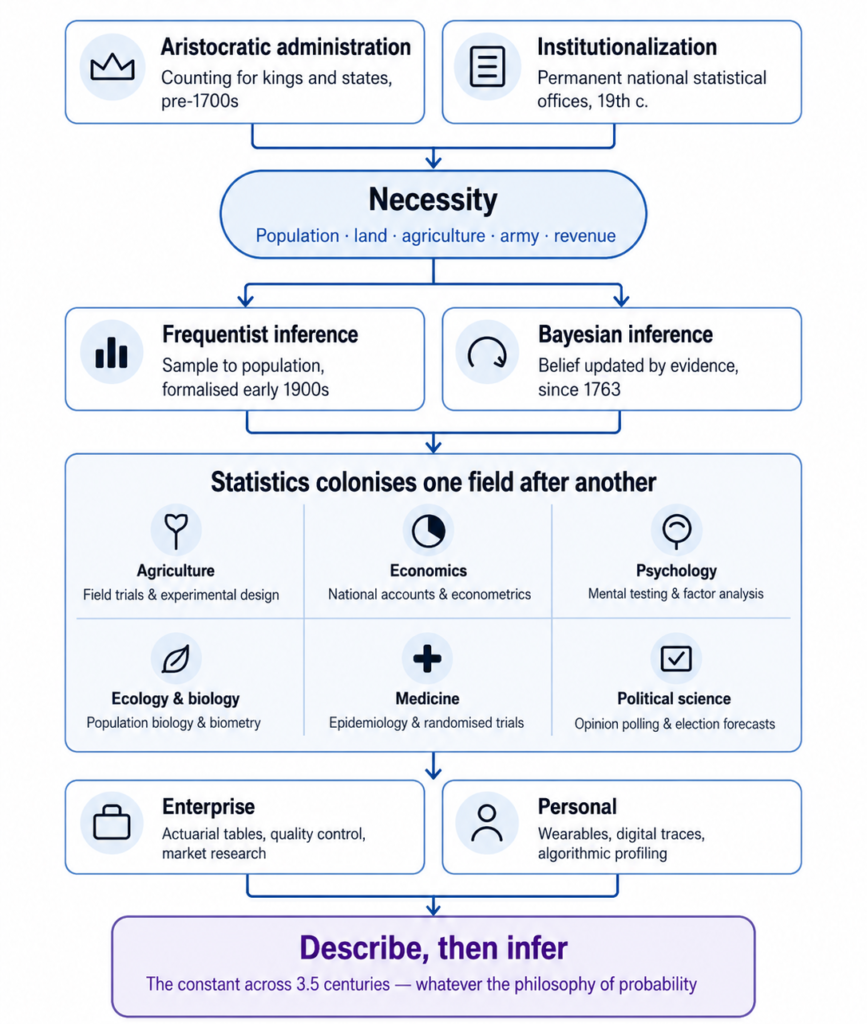
A note on names: statistics was built by many hundreds of clerks, officials, and researchers across three and a half centuries. Where an individual is named below, it is only as an illustrative marker of a period or a method — for example “workers such as Fisher, among many contemporaries” — never as the sole cause of a development that was, in every case, collective and institutional.
1. Origin — Counting for Kings
The discipline did not begin as mathematics. It began as an instrument of rule.
Its root is the Latin status — the condition or standing of a state — by way of the Italian statista, “one skilled in the business of the state”. German university lecturers of the 1660s–1740s taught structured descriptions of a state’s constitution, land, and resources under names like collegium statisticum; by the mid-1700s this body of teaching had settled on the name Statistik.
In England during the same broad period, a separate and more numerical tradition grew out of parish death and christening records, examined to estimate a city’s population, its mortality patterns, and its capacity to field an army or pay tax — work its practitioners called Political Arithmetic.
Both traditions, German and English, served one client: a ruler or ministry that could not govern what it could not see. Their necessity was narrow and consistent — population for taxation and conscription, land and yield for revenue and food security, army strength for defence, and births, deaths, and migration for tracking a state’s condition over time. Statistics, at origin, was simply information assembled for whoever held power over a territory.
2. From Ledger to Institution
Counting for a king is not the same as counting reliably, repeatedly, and independently of who currently sits on the throne. That shift — from an ad hoc royal ledger to a standing civil institution — is a second, distinct development, and it took the better part of two centuries.
Through the 1700s and 1800s, permanent statistical offices were established across Europe and, later, the Americas — central statistical bureaus in the German states from the early 1800s, an Imperial Statistical Office in 1872, national institutes across Latin America following independence, and in the United States a permanent Census Bureau by 1902 alongside agencies for labour and agricultural statistics. Statistics stopped being a service performed for a monarch and became a function of the state itself — professionalised, staffed, and expected to continue regardless of who governed.
3. Two Roads of Inference
Everything so far was still description: here is what the census or the parish register shows. A separate and much harder question — what can this limited record tell us about a population we have not fully observed — produced not one answer but two competing philosophies of probability, both still active today.
The first traces to a short paper on inverse probability, read to the Royal Society in 1763 and shortly afterward extended and popularised on the European continent. This approach treats probability as a degree of belief, updated as evidence arrives. It dominated statistical thinking for well over a century, fell out of favour as a rival approach rose in the early twentieth century, and was kept alive by a small number of researchers through the mid-1900s before resurging — first as a coherent alternative logic of inference, then, once cheap computation made its calculations tractable in the 1980s and 1990s, as a mainstream method now central to modern machine learning.
The second, rival approach treats probability as a long-run frequency and asks whether an observed pattern is likely to be noise. It was formalised in the 1920s and 1930s through significance testing, competing schools of hypothesis testing, and a mathematical theory of sampling that still underwrites every national census, opinion poll, and market survey conducted on less than a full population.
Neither approach replaced the other. Both remain in active use, often side by side in the same field, disagreeing about what probability means while agreeing on the underlying job: describe what was observed, then say something, with stated uncertainty, about what was not.
4. Statistics Colonises One Field After Another
The widest transition in the discipline’s history is not a change in method but a change in territory. Beginning in the 1800s and accelerating through the 1900s, statistics left the exclusive service of the state and was adopted, largely independently, by one field of inquiry after another — each adapting it to a different kind of uncertainty.
In agriculture, permanent experiment stations founded in the mid-1800s struggled for decades with unreliable field trials, until randomisation, blocking, and formal experimental design — developed and refined at these stations from the 1920s — made it possible to separate a genuine treatment effect from ordinary variation in soil and weather.
In economics, the 1930s saw both the founding of societies dedicated to statistical economic modelling and the first systematic national income accounts, built up from incidental estimates that stretched back to the 1600s into standardised measures adopted worldwide by the late 1940s.
In psychology, the early 1900s produced both practical mental testing — developed to identify students needing additional support — and, alongside it, factor analysis, a statistical technique for explaining why scores on different tests tend to correlate.
In ecology and biology, the study of whole populations rather than individual organisms — variation, heredity, and the fit between observed data and theoretical distributions — gave rise to biometry as a distinct field bridging natural history and statistical method through the late 1800s and early 1900s.
In medicine and public health, a physician’s street-by-street mapping of a cholera outbreak in 1854 is now read as an early landmark of spatial epidemiology, and a controlled comparison of a tuberculosis treatment in 1947–48 is widely treated as the first modern randomised controlled trial — the method that now underlies evidence-based medicine.
In political science, a 1936 election survey using a smaller, carefully sampled group of respondents outperformed a rival survey that had mailed ten million ballots, permanently discrediting simple mass response in favour of scientific sampling — and giving rise to the modern polling industry, imperfect as later elections would sometimes show it to be.
None of these transitions had a single author. Each was the work of research communities, institutions, and, in several cases, direct rivalry between competing methods — the common thread being a discipline built for one client, the state, proving adaptable to the empirical problems of a dozen others.
5. From Institution to Enterprise
Government did not keep the discipline to itself for long. Mortality tables built for public administration were repurposed from the 1700s onward to price risk in private insurance. Industrial quality control, formalised in the 1920s through the 1950s, applied sampling and control charts to manufacturing output rather than population counts. Market research, operations research, and corporate forecasting followed through the mid-twentieth century, each adapting the same describe-and-infer machinery to a commercial rather than a civic question.
6. From Enterprise to the Person
The most recent widening brings the discipline to its least aristocratic destination yet: the individual. Consumer analytics, credit scoring, wearable health tracking, and algorithmic recommendation all apply the same inferential toolkit — built originally to describe a kingdom — to a single person’s purchases, movements, and habits. The recipient of statistical knowledge has moved in one direction for three and a half centuries: state, then institution, then enterprise, then person.
7. The Constant
Vocabulary changed. Institutions changed. Even the philosophy of what probability means split into two enduring schools. One thing has not changed since a London haberdasher opened a parish register in the 1660s.
- Describe: characterise what a sample, a state, or a dataset actually shows
- Infer: use that description to say something, with stated uncertainty, about the larger population, market, or process it was drawn from
Every later refinement — significance testing, Bayesian updating, sampling theory, experimental design, machine learning’s predictive models — is an elaboration of this same two-word mandate, not a replacement for it, and not the achievement of any one person credited with inventing it.