
A conceptual framework — from origin to value
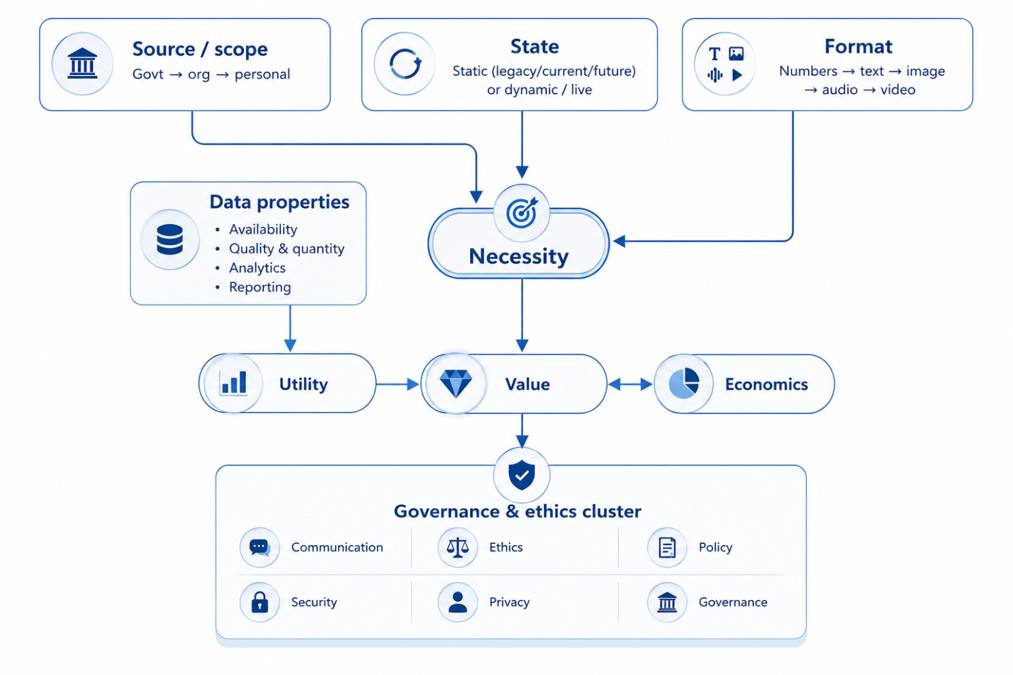
1. Origin & Scope — Who Had Data First
Data creation did not begin equally. It followed a historical sequence driven first by institutional necessity, then by economics, then by technology democratising access to every individual.
- First stage — Government
Primary Driver: Necessity — census, taxation, military, law. The state needed data to function and control. - Second stage— Organisational
Primary Driver: Economics — commerce, operations, competitive advantage. Data became a business asset. - Third stage— Personal
Primary Driver: Technology — devices, platforms, networks put data creation in every individual’s hands.
The driver across all three stages: Necessity $\rightarrow$ Economics.
“It’s all money, honey.“ — every stage ultimately followed where value and power resided.
2. Today — Not a Sequence, a Triangle
The historical sequence above explains how we got here. It does not describe where we are now. Today, Government, Organisation, and Personal data are not separate stages — they are in constant, live, multi-directional exchange.
| Direction | What is actually happening |
|---|---|
| Personal $\rightarrow$ Organisation | Every individual continuously feeds behavioural, locational, transactional data to platforms and corporations. |
| Organisation $\rightarrow$ Government | Corporations are mandated to report, share, and surrender data to states — tax, compliance, national security. |
| Government $\rightarrow$ Personal | States hold the most intimate personal data — health, identity, financial, criminal — and actively expand their collection. |
| Organisation $\rightarrow$ Personal | Platforms profile, predict, and manipulate individual behaviour using data individuals did not knowingly give. |
| Government $\rightarrow$ Organisation | Governments shape what data organisations can collect, hold, and monetise — GDPR, data localisation, AI regulation. |
| Personal $\rightarrow$ Government | Individual behaviour data informs policy, policing, social credit, and national security systems. |
The three scopes are now a triangle of mutual dependency, competition, and tension — each feeding, regulating, and profiting from the others simultaneously.
Governments are among the largest data organisations on earth. The boundary between state and corporation in data terms is increasingly thin.
3. How Data Exists — State
Independently of who holds data, it exists in one of two states. This dimension cuts across all three scopes.
- Static : (Legacy / Current / Future)
Fixed at a point in time. Records, archives, databases. Can be historical (legacy), active (current), or planned (future). - Dynamic : (Live-stream)
Continuously generated and flowing in real time. Sensors, transactions, social feeds, surveillance systems.
4. Format — Not Just Shape, but Engine of New Necessity
Format is more than how data looks. Each new format that emerged did not merely describe data differently — it generated entirely new forms of necessity, new economies, and new power structures that did not previously exist.
- Numbers — Accounting, statistics, scientific measurement — the foundation of institutional data.
- Text — Records, law, communication, publishing — language as data at scale.
- Images — Photography, visual media, social platforms, visual commerce, facial recognition.
- Audio — Broadcasting, music industry, voice interfaces, podcasting, voice bio-metrics.
- Video — Streaming economies, surveillance infrastructure, content platforms, deepfakes.
Format alone generates new necessity and new economics.
Video existing created Netflix, YouTube’s ad economy, and mass surveillance infrastructure. None of those needs existed before the format did.
Each format leap was both enabled by storage science and simultaneously demanded new storage science to handle it.
5. Storage Science — The Co-Evolutionary Engine
Data storage is not a passive container. It is an independent science in continuous evolution — and that evolution both enabled and was driven by advances in scope and format. Without storage science advancing, no other dimension of data could have progressed.
| Era | Storage Science | What it unlocked |
|---|---|---|
| Early | Paper, physical filing systems | Organised government and institutional records at scale. |
| Mid 20th C | Electronic storage, punch cards, tapes | Machine-readable data — the birth of computing as a data tool. |
| 1970s–90s | DBMS, relational databases, SQL | Structured querying — data became retrievable, relational, and analytically useful. |
| 2000s | NoSQL, distributed systems | Unstructured and massive-scale data — the internet’s explosion made relational models insufficient. |
| 2010s–now | Cloud, data lakes, real-time streaming | Infinite scalable storage — enabled video, IoT, AI training data, and live analytics. |
| Emerging | Edge computing, quantum storage | Processing at source, near-infinite density — the next leap in what data can be and do. |
Storage science and format evolution are bidirectional — each drives the other.
Video demanded cloud-scale storage. Cloud storage made video ubiquitous. New formats cannot exist without storage to hold them; new storage capabilities make new formats economically viable.
6. From Data to Utility to Value
As data matured across all dimensions — scope, state, format, and storage — a consistent chain emerged. Data alone is inert. It becomes valuable only through use.
Data $\rightarrow$ Data Utility $\rightarrow$ Value
Utility is the bridge. Data generates utility when it is available, accessible, and usable. Utility then generates Value — economic, political, social, strategic. And it is Value that changes everything that follows.
7. What Value Gives Rise To
Once data carries Value, an entire cluster of questions, obligations, and battles immediately emerges. The “+” here means gives rise to — these are not additions to data, they are the inevitable consequences of data mattering. And at their core, every one of them is a question about Value — who owns it, who protects it, who controls it, who profits from it.
- + Communication — How data is shared, transmitted, and interpreted across actors
- + Security — Protecting data from breach, theft, misuse — a direct function of its value
- + Privacy — Who owns personal data, and what rights individuals retain over it
- + Ethics — The moral questions of how data is collected, used, and weaponised
- + Policy — The organisational and national rules that govern data behaviour
- + Governance — The structures — legal, institutional, technical — that enforce those rules
These are not a compliance checklist. They are the value battlefield.
Privacy is a fight over who owns the value in personal data. Security is a fight over who can access and exploit that value. Ethics is the question of whether the value justifies the means. Policy and Governance are the arenas where those fights are formally contested.
8. The Operational DATA Loop
Grounding everything is the practical cycle through which data continuously generates and regenerates value:
- Availability — Can the data be accessed when and where it is needed?
- Quality & Quantity — Is it accurate, complete, consistent, and sufficient in volume?
- Analytics — Inferential — What does the data tell us about what has already happened?
- Analytics — Predictive — What does it tell us about what will happen next?
- Reporting — How are the findings communicated to those who act on them?
DATA Loop $\rightarrow$ Utility $\rightarrow$ Value $\rightarrow$ feeds directly back into the governance and value cluster above